Evaluating the soil, rock, and groundwater conditions that shape every project.
Why Geotechnical Data Shapes
More Than Foundation Design
Intertek-PSI provides geotechnical engineering, drilling, laboratory testing, and geotechnical consulting services for building and infrastructure projects. Services include preliminary and complete geotechnical studies, field exploration, laboratory testing, foundation and settlement analysis, slope stability, pavement design, seismic and liquefaction analysis, groundwater evaluation, and construction-phase consulting.
Our engineers, geologists, drilling crews, and laboratory technicians evaluate soil, rock, and groundwater conditions that may affect foundation selection, earthwork, retaining structures, slopes, pavements, construction methods, project cost, and schedule.
With local knowledge, a national footprint, and extensive engineering, drilling, and laboratory resources, owners, developers, designers, and contractors can work with professionals who are familiar with regional terrain, geology, regulations, and construction practices.
How Does Intertek Support Geotechnical Engineering Projects?
Every development begins with the ground beneath it.
A site may appear ready for construction, yet underlying conditions may include soft or compressible soil, uncontrolled fill, shallow groundwater, shifting rock conditions, or other subsurface features. These conditions can affect foundation depth, excavation, site grading, pavement systems, and construction methods.
Intertek develops geotechnical programs based on the proposed project, anticipated structural loads, site characteristics, and available geologic information. Depending on the scope, services may include preliminary studies, subsurface exploration, drilling and sampling, laboratory testing, engineering analysis, reporting, and construction-phase consulting.
The findings help project teams identify potential engineering constraints and evaluate options for earthwork and foundations before construction begins.
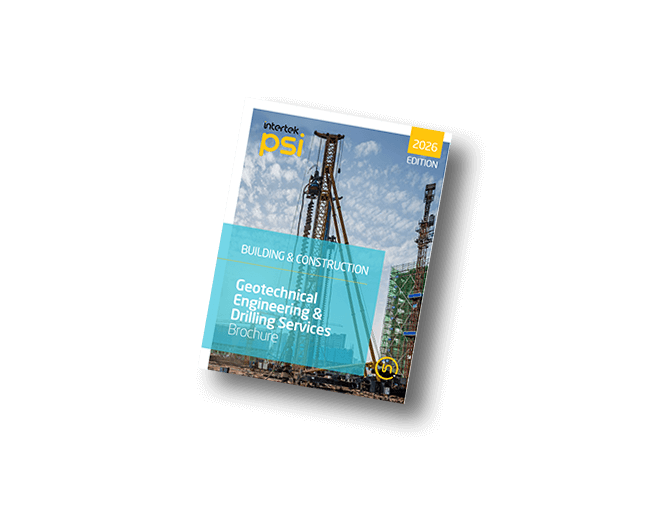
Intertek-PSI’s geotechnical engineering and drilling services bridge the gap between raw site materials and resilient finished structures, providing advanced analyses that can uncover potential engineering constraints. Download our brochure to learn more.
What Is Geotechnical Engineering, and Why Is It Important?
Geotechnical engineering is a branch of civil engineering focused on the physical and mechanical properties of soil and rock and on how they interact with engineered structures.
Geotechnical investigations apply that expertise to a specific site through drilling, sampling, field testing, laboratory analysis and engineering calculations. The findings help project teams understand how soil, rock and groundwater may respond to structural loads, excavation, changes in moisture and construction activity.
Common applications include the design and analysis of foundations, slopes, embankments, retaining walls, tunnels, pavement systems, floor slabs, and earthwork. Investigations may also assess groundwater conditions that could affect design or construction.
Surface conditions alone do not tell the full story of a project site. Unexpected subsurface conditions found during construction may require changes to the foundation, additional excavation, soil improvement, dewatering, or revisions to the construction sequence. A geotechnical investigation provides representative site data earlier, so the findings can still inform planning and design.
Geotechnical investigations do not remove all subsurface uncertainty. They provide findings and engineering recommendations based on the completed field explorations, laboratory results, and project information available at the time of the study.
Intertek Geotechnical Engineering Services
Intertek supports projects through a combination of field exploration, laboratory testing, and engineering analysis.
| Service | Project Application |
| Preliminary geotechnical studies | Provide an initial understanding of expected soil and site conditions before development plans are finalized |
| Subsurface investigations | Identify soil, rock, and groundwater conditions through field exploration |
| Drilling and sampling | Collect representative soil and rock samples for classification and testing |
| Geotechnical laboratory testing | Measure soil characteristics and responses to applied loads and stresses |
| Foundation design and analysis | Evaluate shallow and deep foundation options based on site conditions and structural loads |
| Bearing capacity and settlement analysis | Assess the ability of subsurface materials to support proposed construction |
| Slope and retaining wall analysis | Evaluate natural slopes, embankments, excavations, and retaining systems |
| Pavement design | Evaluate subgrade conditions and develop pavement recommendations |
| Seismic and liquefaction analysis | Assess potential soil behavior during seismic events |
| Geohazard assessment | Identify geological or subsurface conditions that may affect design or construction |
| Geological studies | Evaluate geologic conditions and features that may influence site development, design, or construction |
| Groundwater flow analysis | Evaluate groundwater conditions and their potential effects on the project |
| Construction-phase consulting | Provide geotechnical review as site conditions are exposed during construction |
The appropriate combination of services depends on the project type, design stage, site conditions, and engineering questions to be addressed.
What Is Included in an Intertek Subsurface Investigation?
A subsurface investigation gathers information about the soil, rock, and groundwater beneath a proposed project.
The geotechnical team begins by reviewing available site plans, project information, and geologic data. Engineers then develop an exploration program based on the proposed construction, anticipated loads, and site conditions.
Field exploration may include soil borings, rock coring, drilling, sampling, test pits, groundwater observations, and in-place testing. Field-collected samples may be sent to a geotechnical laboratory for classification and additional testing.
The number, location, and depth of explorations vary by project. A roadway corridor, building, retaining wall, and utility project each pose distinct engineering questions and require a scope tailored to the planned work.
Intertek Geotechnical Drilling and Field Exploration Services
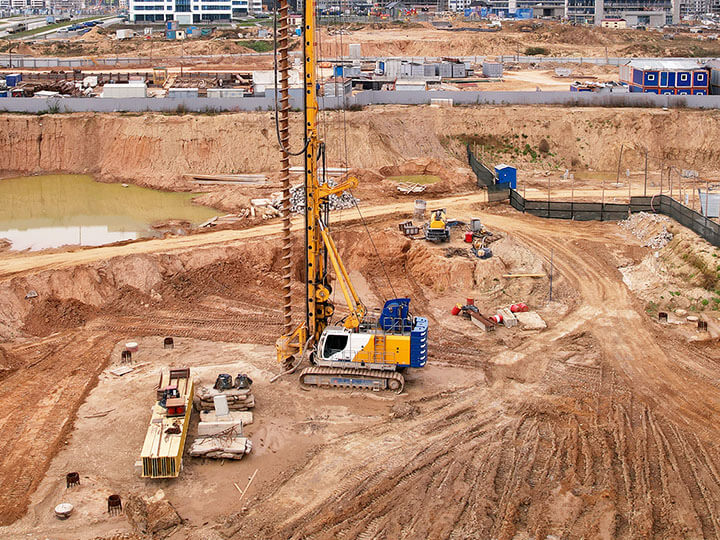
Drilling provides direct information about the materials beneath a site.
Soil borings can document changes in soil type, consistency, and density with depth. Rock coring may be used to evaluate the depth and condition of bedrock. Test pits can provide a broader view of shallow soil, fill, or buried materials.
Field programs may also include Standard Penetration Testing, groundwater sampling and monitoring, or other exploration methods selected for the project.
Field observations are evaluated alongside laboratory results and engineering analyses. Together, this information supports the findings and recommendations presented in the geotechnical report.
What Geotechnical Laboratory Testing Does Intertek Provide?
Intertek-PSI conducts more than 2 million individual field and laboratory material tests each year.
Geotechnical laboratory testing provides data on site characteristics and on how soil may respond to applied loads, moisture, and other stresses. The testing program is developed around the materials encountered and the information needed for engineering analysis.
Laboratory results may be evaluated with engineering analysis and, when appropriate, numerical modeling to support project-specific design, construction, and maintenance recommendations.
| Testing Area | Information Provided |
| Soil classification | Soil type and engineering characteristics |
| Compaction | The relationship between moisture content and dry density |
| Consolidation | Potential soil compression and settlement under applied loads |
| Shear strength | Resistance to sliding or deformation |
| Permeability | How readily water moves through soil |
| Shrink-and-swell behavior | Potential volume changes as moisture conditions vary |
| Field bearing capacity | The ability of soil or prepared subgrade to support an applied load |
Testing is conducted by engineers and technicians using established procedures and industry practices, with oversight from Intertek-PSI’s engineering leadership.
How Does Intertek Geotechnical Engineering Support Foundation Design?
Foundation design depends on the proposed structure, anticipated loads, and the capacity of the underlying soil or rock.
Intertek evaluates subsurface conditions and structural information to develop project-specific foundation recommendations. Depending on the soil profile and proposed construction, recommendations may address shallow and deep foundations, site preparation, ground improvement, or other earthwork and foundation solutions.
Engineering analysis may consider bearing capacity, total and differential settlement, groundwater, lateral loads, seismic hazards, and general construction conditions.
The geotechnical report may also provide recommendations for subgrade preparation, floor slabs, excavation, fill placement, and other work that affects foundation performance.
What Is an Intertek Preliminary Geotechnical Study?
A preliminary geotechnical study is a smaller-scale initial site review conducted before project plans and structural characteristics are fully developed.
The study can provide an early understanding of expected geologic and soil conditions, as well as potential foundation considerations. It may include a review of available records, limited subsurface exploration, laboratory testing, preliminary site characterization, and recommendations for the final field exploration program.
Preliminary studies can support early site selection, feasibility discussions, and development planning. They do not replace a complete project-specific study once the layout, loads, and design requirements are known.
What Is Included in an Intertek Geotechnical Study?
A complete geotechnical study is developed for a defined project with a known or anticipated layout, structural characteristics and loading conditions.
The scope may include subsurface evaluation, drilling and sampling, site characterization, soil testing, construction materials investigation, bearing capacity analysis, foundation recommendations, settlement analysis, and general construction considerations.
Depending on the project, the study may also address retaining walls, slope stability, pavement design, geological studies, seismic hazards, liquefaction, geohazards, vibration, and groundwater flow.
The resulting geotechnical report documents the conditions encountered and offers engineering recommendations for the proposed construction.
How Does Intertek Support Transportation Projects?
Roadways, rail systems, and other transportation corridors may cross changing terrain, soil, rock, and groundwater conditions.
Intertek provides geotechnical corridor studies that can support foundation, embankment, retaining wall, and pavement design. Services may include subsurface investigations, drilling and sampling, geotechnical risk assessments, groundwater sampling, instrumentation, monitoring and corridor-level fatal-flaw analysis.
Transportation work may also address borrow materials, flood and stormwater management facilities and design requirements under the American Association of State Highway and Transportation Officials’ Load and Resistance Factor Design specifications.
Combining geotechnical engineering with environmental, infrastructure and construction materials services can provide coordinated support across planning, design and construction.
How Does Intertek Support Utility and Pipeline Corridors?
Utility and pipeline projects often extend across multiple geologic settings, environmental conditions, and regulatory jurisdictions.
Intertek’s corridor services may support route selection, alignment planning, subsurface investigation, drilling, geotechnical risk assessment, groundwater sampling, geotechnical quantities estimation, and foundation, embankment, or retaining wall design.
These projects may also require environmental assessments, environmental impact statements, permitting and regulatory compliance, wetland and protected-species analysis, cultural-resources evaluation and National Environmental Policy Act documentation.
Coordinating geotechnical and environmental services can help project teams evaluate the engineering and regulatory conditions encountered along a proposed corridor.
How Does Local Geotechnical Experience Support a Project?
Soil, rock, groundwater, and terrain vary from one region to another. Local regulations and construction practices also influence how projects are investigated, designed, and built.
Intertek-PSI’s national footprint gives clients access to engineering teams familiar with local terrain and regulatory requirements, backed by resources that can support fast-track schedules and major projects.
When Should Geotechnical Engineering Begin?
Geotechnical engineering provides the greatest value when findings are available early enough to inform project decisions.
A preliminary study may support site selection, acquisition, or feasibility planning. A complete geotechnical investigation can provide recommendations as structural and civil designs are developed. During construction, geotechnical professionals can review field-exposed conditions and address questions as work progresses.
Early involvement gives project teams time to consider subsurface findings in plans, budgets, schedules and construction strategies.
What Is Included in an Intertek Geotechnical Report?
A geotechnical report documents the investigation methods, subsurface conditions, laboratory results, engineering analysis, and recommendations for the project.
Depending on the project scope, the report may include:
- Site and proposed construction information
- Exploration locations and depths
- Soil, rock, and groundwater conditions encountered
- Laboratory testing results
- Engineering analysis and design parameters
- Recommendations for foundations, settlement, earthwork, pavements, retaining walls, slopes, groundwater, and construction
The report should be reviewed as a complete document because its findings and recommendations are based on the proposed project and the conditions identified at the exploration locations.
How Does Intertek Support Projects During Construction?
Geotechnical conditions become visible across a broader portion of the site as excavation and construction proceed.
Intertek can provide geotechnical consulting during construction to evaluate exposed conditions, respond to field questions, and determine when additional review, testing, or analysis may be appropriate.
Intertek also provides construction materials testing and inspection for concrete, soils, asphalt, structural steel, masonry, and other materials. Coordinating geotechnical and construction materials services can provide continuity from the initial subsurface investigation through construction.
Intertek's Geotechnical Engineering Services:
Frequently Asked Questions (FAQs) about Geotechnical Engineering
A geotechnical engineer evaluates soil, rock, and groundwater and analyzes how these conditions may affect foundations, earthwork, slopes, retaining walls, pavements, and other engineered structures. The engineer uses field exploration, laboratory testing, and engineering analysis to develop design and construction recommendations.
Soil testing provides data on soil classification, compaction, strength, settlement, permeability, and moisture-related behavior. Engineers use this information to develop project-specific recommendations for foundations, earthwork, pavements, floor slabs, and other systems.
Boring depths depend on the proposed construction, anticipated structural loads, potential foundation systems, and subsurface conditions. The exploration program is designed to evaluate soil and rock that may affect foundation performance, settlement, excavation, or other project requirements.
A geotechnical investigation can document groundwater encountered during field exploration and may include groundwater sampling, monitoring, or flow analysis. Groundwater levels can vary with weather, seasonal conditions, construction activity, and site changes.
A preliminary study provides an early understanding of expected site conditions before the project is fully defined. A complete geotechnical investigation is conducted for a specific project and includes field exploration, testing, and engineering analysis needed to prepare design and construction recommendations.
A geotechnical report typically includes site and project information, exploration methods, subsurface findings, laboratory results, engineering analysis, and recommendations for the project elements within the scope. Recommendations may address foundations, settlement, earthwork, pavements, groundwater, slopes, retaining walls, and construction considerations.
A soil boring provides information about subsurface conditions at selected depths and allows soil or rock samples to be collected at those depths. A test pit exposes a wider area of shallow soil and may be useful for examining fill, buried materials, or near-surface conditions. The appropriate method depends on the project, anticipated subsurface conditions, and engineering judgment.
Intertek can provide geotechnical consulting during construction, as excavation and site work may expose additional conditions. Services may include reviewing field conditions, responding to geotechnical questions, and determining when additional investigation, testing, or engineering analysis may be appropriate.
Geotechnical testing evaluates soil, rock, and groundwater to support engineering design and recommendations for foundations, earthwork, slopes, pavements, and related systems. Construction materials testing evaluates materials and installation during construction, including concrete, asphalt, structural steel, masonry, and soils used in fills and prepared subgrades.
Intertek can support large or multisite projects through a national network that integrates local geotechnical expertise with field exploration, drilling, laboratory testing, and engineering resources. This structure allows for consistent service across multiple locations, fast-track schedules, major developments, and infrastructure assignments spanning markets or jurisdictions.
Related Intertek Services
- Subsurface Investigations and Exploration
- Ground-Penetrating Radar Surveys
- Foundation Design and Analysis
- Construction Materials Testing and Inspection
- Environmental Consulting Solutions
- Geotechnical Engineering and Drilling
- Infrastructure Solutions
- Major Projects
- Intertek-PSI Locations
Contact an Intertek Geotechnical Engineering Specialist
Talk with Intertek about geotechnical engineering, drilling, soil testing, subsurface investigations, foundation analysis, or corridor studies for your next project.
Related Links
27 Feb 2026
Beyond the Foundation
How Early Geotechnical Data Influences Planning, Construction Risk, and Long-Term Performance
Featured on #YoullBeAmazed
See this post on LinkedIn or learn more about our You'll Be Amazed campaign.


Building & Construction Geotechnical Engineering Services


Knowledge Center
Building Health & Wellness: An Overview of Services
Acoustical Testing & Consulting Resources
Remote Pre Inspections for NFPA 80 / 101
Protek - Safety. Everywhere. Every Day
Fire Doors 101: Your Guide to Testing and Certification - Webinar Recording
Tornado Testing & Certification Requirements - Webinar Recording
Plumbing Products Testing & Certification - Webinar Recording
The Evolving Code Evaluation Process White Paper
Proposition 65 & the Furniture Industry Webinar Recording
Why Planning for FCC Certification is Key to Success in the Door Hardware Industry White Paper
Upcoming Tradeshows & Events
Resources